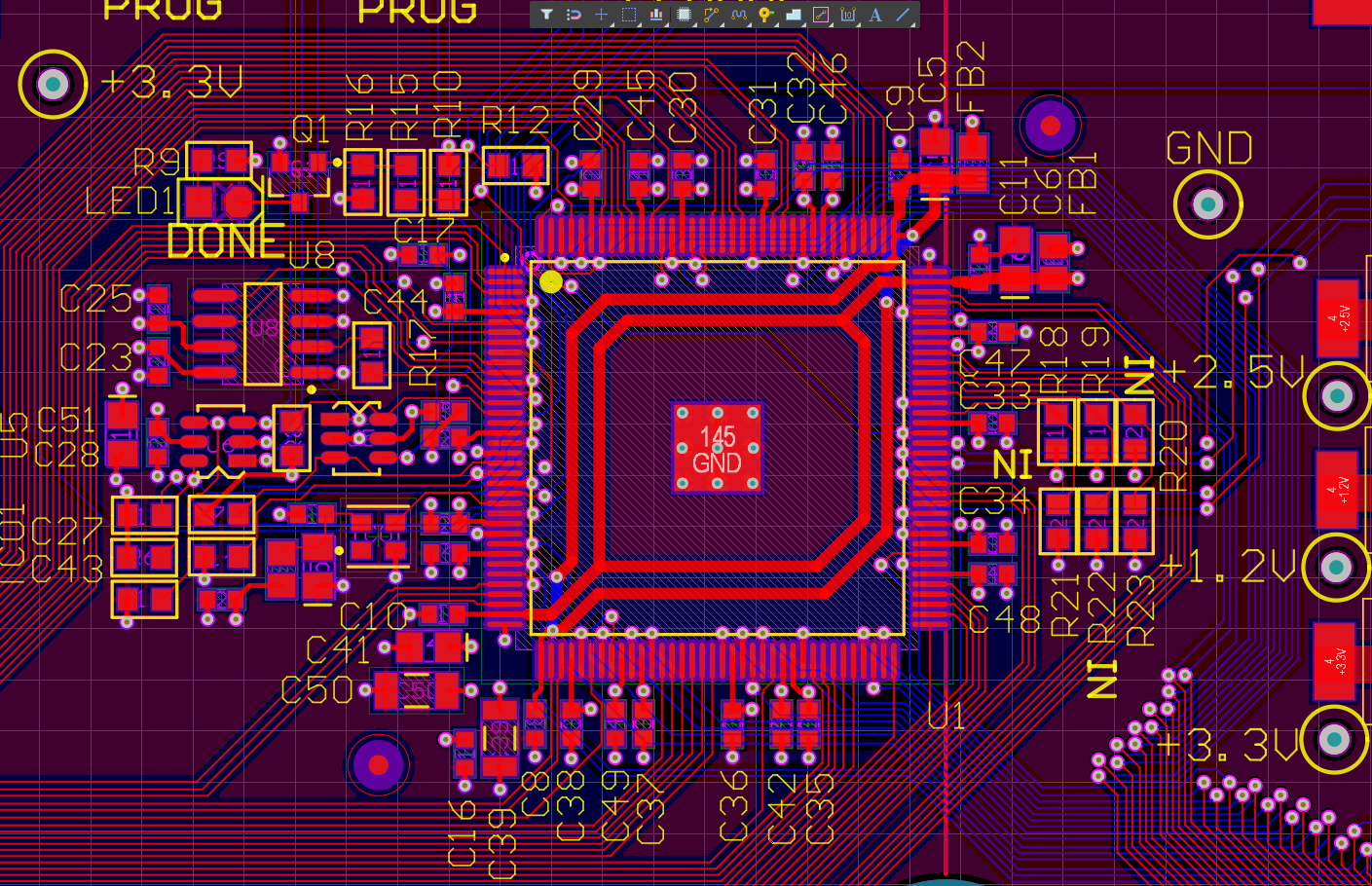
Engineering from First Principles

Hardware design isn't just about connecting components. It's about understanding system-level interactions, power distribution, thermal management, signal integrity, and manufacturing constraints. We approach every design from first principles - starting with requirements, building block diagrams, analyzing trade-offs, and creating detailed implementations that work in the real world.

DFM

Design for Manufacturing

Every design optimized for yield, cost, and producibility from day one.

Thermal

Thermal Analysis

Power dissipation calculations, heat sink sizing, thermal modeling.

Power

Power Distribution

Sequencing, regulation, protection, and decoupling strategies.

EMI/EMC

EMI Mitigation

Design practices to meet radiated and conducted emissions requirements.

Our Design Process

Systematic approach from concept to production-ready design.

1. Requirements Capture

We start by understanding your needs:

  • Functional requirements (what the system must do)
  • Performance requirements (speed, accuracy, throughput)
  • Environmental requirements (temperature, humidity, shock/vibe)
  • Regulatory requirements (FCC, CE, UL, safety standards)
  • Cost targets and production volumes
  • Timeline and milestone constraints

Deliverable: Requirements specification document with success criteria

2. System Architecture

High-level design and component selection:

  • Block diagram development
  • Processor/controller selection (ARM, FPGA, microcontroller)
  • Interface definition (USB, Ethernet, SPI, I2C, etc.)
  • Memory architecture and sizing
  • Analog signal chain design
  • Component vendor selection and qualification

Deliverable: System block diagram, BOM estimate, risk analysis

3. Power Budget & Analysis

Critical for battery-powered and high-performance designs:

  • Power consumption estimation for all ICs
  • Battery sizing and runtime calculations
  • Regulator selection and efficiency analysis
  • Power sequencing requirements
  • Inrush current and brownout protection
  • Load switch and power gating strategies

Deliverable: Power budget spreadsheet, regulator selection

4. Thermal Management

Preventing thermal failures before they happen:

  • Power dissipation calculations (P = I²R, switching losses)
  • Junction temperature estimation (Tj = Ta + (θJA × P))
  • Heat sink selection and sizing
  • Thermal interface material (TIM) selection
  • Forced air vs. natural convection analysis
  • Component derating for reliability

Deliverable: Thermal analysis report, cooling strategy

Technical Expertise Areas

Power Distribution Network (PDN)

Clean, stable power is fundamental to reliable operation.

Linear Regulators

  • LDO selection: Dropout voltage, PSRR, load regulation
  • Thermal: Power dissipation P = (Vin - Vout) × Iload
  • Stability: Output capacitor ESR requirements
  • Use cases: Low noise analog supplies, post-regulation

Switching Regulators

  • Buck converters: High efficiency, step-down
  • Boost converters: Step-up, battery-powered
  • Buck-boost: Wide input range applications
  • Inductor selection: DCR, saturation current, ripple
  • Layout critical: Hot loop minimization, GND planes

Decoupling Strategy

  • Bulk capacitors: 10-100µF electrolytic/ceramic
  • High-frequency: 0.1µF ceramics at every IC
  • Ultra-HF: 0.01µF for GHz-range transients
  • Placement: Short traces, multiple vias to GND plane

Processor & Memory Systems

Selecting the right processor for your application.

Microcontroller Selection

  • ARM Cortex-M: M0+ (low power), M4 (DSP), M7 (performance)
  • Peripherals: ADC, DAC, timers, communication interfaces
  • Memory: Flash, RAM, EEPROM requirements
  • Power modes: Sleep, deep sleep, shutdown currents

Memory Architecture

  • SRAM: Fast, volatile, larger die size
  • DRAM/DDR: High density, requires refresh, complex routing
  • Flash: NOR (XIP), NAND (storage), eMMC
  • External memory: SPI, Quad-SPI, parallel interfaces

Clock Distribution

  • Crystal selection: Frequency accuracy, load capacitance
  • Oscillator stability: PPM over temperature
  • PLL configuration: Jitter, phase noise considerations
  • Clock routing: Impedance control, length matching

Analog Signal Conditioning

Precision analog design for sensors and data acquisition.

Amplifier Selection

  • Op-amps: GBW, slew rate, input offset, noise
  • Instrumentation amps: CMRR, gain accuracy
  • Difference amps: High-side sensing, isolated
  • Rail-to-rail: Single-supply applications

ADC Design

  • Resolution: 12-bit, 16-bit, 24-bit selection
  • Sample rate: Nyquist, oversampling considerations
  • Anti-alias filtering: Cutoff frequency, order
  • Reference: Voltage reference stability, tempco
  • SNR/ENOB: Effective number of bits in real conditions

Sensor Interfaces

  • Thermocouples: Cold junction compensation
  • RTDs: 2-wire, 3-wire, 4-wire configurations
  • Load cells: Wheatstone bridge, excitation
  • Current loops: 4-20mA industrial standards

EMI/EMC Design Practices

Meeting regulatory requirements for emissions and immunity.

Radiated Emissions

  • Clock management: Spread-spectrum clocking
  • Edge rates: Slow down unnecessarily fast signals
  • Cable shielding: 360° termination, pigtails
  • Enclosure design: Seams, gaps, apertures

Conducted Emissions

  • Input filtering: Common-mode, differential-mode
  • Ferrite beads: Impedance vs. frequency selection
  • Power supply design: Switching regulator layout
  • Ground strategy: Single-point, multi-point, hybrid

ESD Protection

  • TVS diodes: Clamping voltage, capacitance
  • Series resistance: Current limiting
  • ESD test levels: Contact (4kV), air (8kV), IEC 61000-4-2
  • PCB design: Ground pour under connectors

Design Tools & Analysis

We use industry-standard tools for simulation and analysis.

Schematic Capture

  • Altium Designer (primary platform)
  • OrCAD / Cadence (legacy support)
  • KiCad (open-source projects)
  • Hierarchical, multi-sheet designs
  • Design rule checking (DRC)
  • Bill of Materials (BOM) generation

SPICE Simulation

  • LTspice for power and analog circuits
  • AC/DC analysis, transient response
  • Component stress analysis
  • Worst-case analysis (temperature, component tolerances)
  • Monte Carlo analysis for yield prediction

Thermal Modeling

  • Analytical calculations (θJA, θJC)
  • Heat sink sizing and CFD when needed
  • Component derating curves
  • Reliability calculations (MTBF, FIT rates)
  • Thermal camera validation

Signal Integrity

  • Impedance calculations (microstrip, stripline)
  • Transmission line analysis
  • Reflection, crosstalk, EMI simulation
  • Eye diagram analysis for high-speed digital
  • SI/PI co-simulation

Component Selection & Sourcing

Selection Criteria

  • Performance: Does it meet electrical specifications?
  • Availability: Lead times, multiple distributors
  • Longevity: Product lifecycle, not going obsolete soon
  • Cost: Unit price at production volumes
  • Thermal: Operating temperature range adequate
  • Packaging: Hand-solderable for prototypes, production-friendly

Vendor Qualification

  • Authorized distributors (Digi-Key, Mouser, Arrow)
  • Direct from manufacturer for production
  • Second-source options when critical
  • Counterfeit risk mitigation
  • Lead-time management and allocation

Design for Cost

  • Standard component values (E12, E24 series)
  • Minimize unique part numbers
  • Volume pricing break points
  • Avoid exotic packages (QFN/DFN preferred over BGA when possible)
  • Cost vs. performance trade-off analysis

Obsolescence Management

  • PCN (Product Change Notification) monitoring
  • PDN (Product Discontinuation Notice) tracking
  • Alternative component identification
  • Last-time-buy decisions
  • Redesign planning for EOL components

Design Deliverables

Complete documentation package for manufacturing and support.

1

Requirements

Specification document, block diagram, success criteria

2

Analysis

Power budget, thermal analysis, BOM cost estimate

3

Schematics

Multi-sheet hierarchical design with DRC clean

4

BOM

Complete bill of materials with vendor part numbers

5

Documentation

Design notes, test procedures, manufacturing notes

Ready to Start Your Design?

Let's discuss your system requirements and design constraints.

Get in Touch